
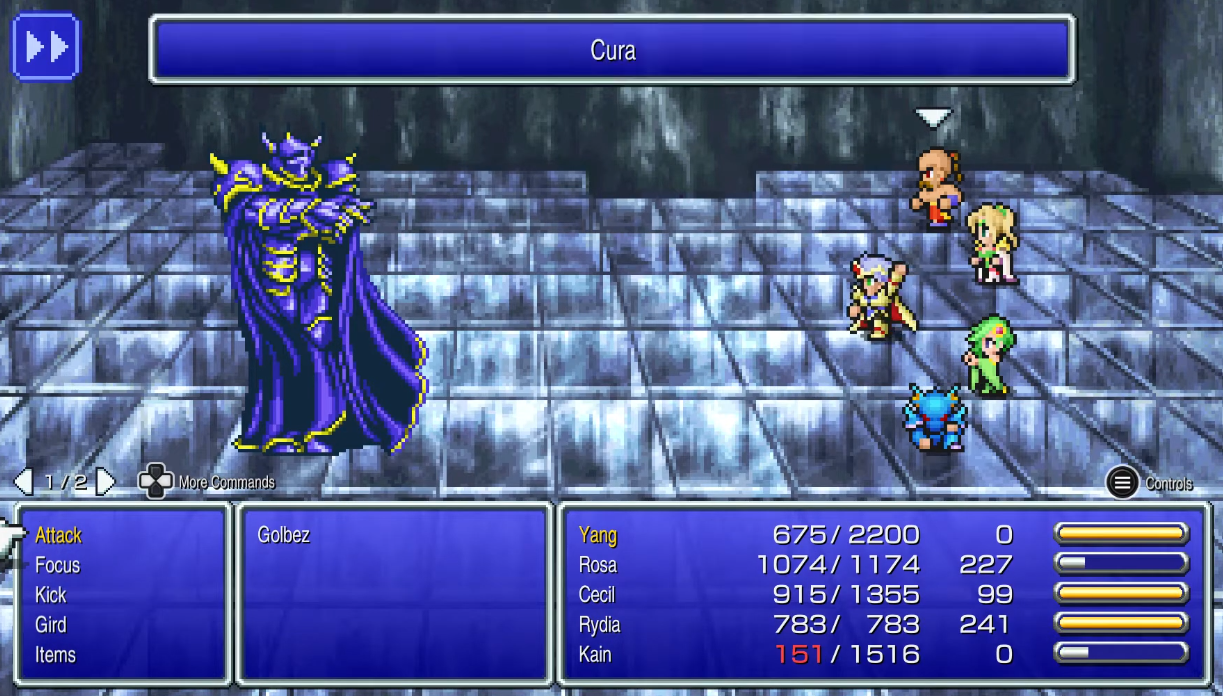
Version played: Pixel Remaster
Final Fantasy IV is a very beloved game and a landmark title in the series. It's the first game in the series to be released on the Super Nintendo, and second title the west ever got, being released as Final Fantasy II. The jump from the NES to the SNES lends the game an incredible boost in presentation narratively, graphically, and audibly, leading to long-lasting fan favoritism. It's referenced constantly, both by its own series and by the wider JRPG landscape. Kain is nearly a series mascot all on his own. People love FF4. And it's for good reason! The game is quite good. I wouldn't say it revolutionised the JRPG landscape but it certainly helped in its growth into what it is today.
One of the game's most notable points is its focus on a larger, more fleshed out story. Previous mainline titles absolutely had some plot in them but it ranged from "basically nonexistent" to "the barest of bones". FFII was probably the most fleshed out in this regard, but it mostly felt like you were being told events that had happened, rather than a story. FFIV strives to surpass this and then some, with in-depth characters and a plot full of twists and turns that feels like a far cry from the NES titles. Cecil is a man who has committed heinous crimes in the name of his country, who eventually recognizes what he has done and strives to do as much as he can to atone for his actions. Kain is his close friend who seems to harbor a bit of a complex about being in Cecil's shadow. Rydia is an orphaned child that eventually morphs from a scared, frail little girl to a strong, confident summoner. It's not a game that shies away from darker topics either. Characters die, cities get bombed, wars are declared. It gets pretty serious, with an almost constantly rotating party up until the very end of the game.
To assist in this new focus on storytelling, the game eschews any of the systems from the previous games in favor of something new to the series: dedicated character skillsets and the iconic ATB system. Gone are the days of choosing your party at the start. Instead, every character has their own set of skills and abilities, usually pulling from preexisting series jobs. Kain, for instance, is a dragoon, and thus has the iconic Jump command. Rosa is your white mage, while Rydia is a combination black mage / summoner. Tying specific skills to specific characters allows for interesting storytelling; most notably Cecil's transformation from a dark knight to a paladin, swapping his signature ability, the selfish and self-destructive HP-consuming Darkness, with a more noble and selfless Cover and access to white magic. Another instance is Rydia refusing to use Fire until absolutely necessary since her entire village died in the flames Cecil created (It's kinda funny that she can actually summon the creature that caused it, but you can only get the item that teaches her that summon after she returns from her growing up training arc in the Land of Summons so she can't actually learn it as a child).
So after all that, what do I think of it? I dunno. It's fine.
Ok, so here's the thing: I've kinda been fudging the details this whole time. Most of what I've mentioned when it comes to the plot and gameplay of this title is about all it gives you. Character personalities and motivations, while certainly more fleshed out than previous titles, still feel like you're reading the blurb on the back of the box. A lot of the time, they either just end after their defining character moment or don't really get one at all. Cecil, for instance, is great in the beginning of the game, and the paladin sequence is also good. But afterwards, he's just... is good guy. It works less as a signifier of his acceptance of his actions and a willingness to move forward in atonement and more as "I recognize my crimes and am very sorry for them" and then all is forgiven. I'm not asking for him to prostrate himself in front of every person on the planet but a little more pushback, a little more commentary from the world on it would be nice. It's the same with some of the other characters. I like Rydia's arc from scared girl to gaining more confidence in herself when she is a child but after her stint in the Land of Summons she doesn't end up doing much. Which would be fine, if it were there to give other characters the spotlight, but nobody else really gets any character development after that. The most extraneous information I know about Edge is that he has a crush on Rydia. Don't even get me started on Golbez, who shows up to be menacing and does basically nothing up until the final twist of the game, where it's revealed he's Cecil's long-lost brother. And then he leaves.
Gameplay-wise, it has some shortcomings too. The game doesn't really get good use out of the new ATB system (outside of a few notable exceptions like Zeromus and the Mist Dragon), effectively ending up as "normal turn order but you're on a timer". The dedicated skills for each party member is a cool idea and they do get some good use out of it, but the storytelling potential isn't utilized properly, with Cecil and Rydia being the two exceptions to the norm, with Edward at a distant third. It's also extremely easy to tell what party members will be with you at the end and which will end up leaving. Compare Cid, who only has Analyze, with Edge, who comes with Steal, Throw, and a list of Ninjutsu to pick from. Which character seems like they had more development time put into their skill lists?
Look, the game is good. Great even! I would never call it bad, or even mediocre. But, and if you will allow me a moment to explain, it, and to a lesser extent most of the early games on this list, is kinda too famous and influential. We've hit the point where a game with a fleshed out story, unique gameplay, and a notable soundtrack isn't really that special anymore. The people who grew up playing this game are now in the games industry making their own games. I am not one of those people. My beginning was with the Nintendo Wii, and a lot of my JRPG history comes from games released since 2010. Things have had time to be fleshed out, evolve, and be deconstructed, and FF4's DNA has been spread around the landscape so thoroughly that it kind of comes off as... well, simple. Basic. Which isn't outright bad, mind you. I certainly prefer a simpler narrative that I have some issues with to something that waffles endlessly about troop movements from the north to the south and then pretends that says something profound on slavery. But it does, at the end of the day, leave me wanting something more.
I'll put it like this. "Done better since" is a moniker I simultaneously subscribe to and try to avoid using because something being handled better after the fact does not necessarily detract from what came before, especially if what came before is a foundational text in a genre. That being said, sometimes you play something and just go "This was fine but I can think of five games better than it off the top of my head". Final Fantasy IV fits that to a T.
Golbez is really fuckin' cool though. Love that armor.
Link to next game